
I Left My Dream Job: The Chronic Underestimation of "Soft Skills"
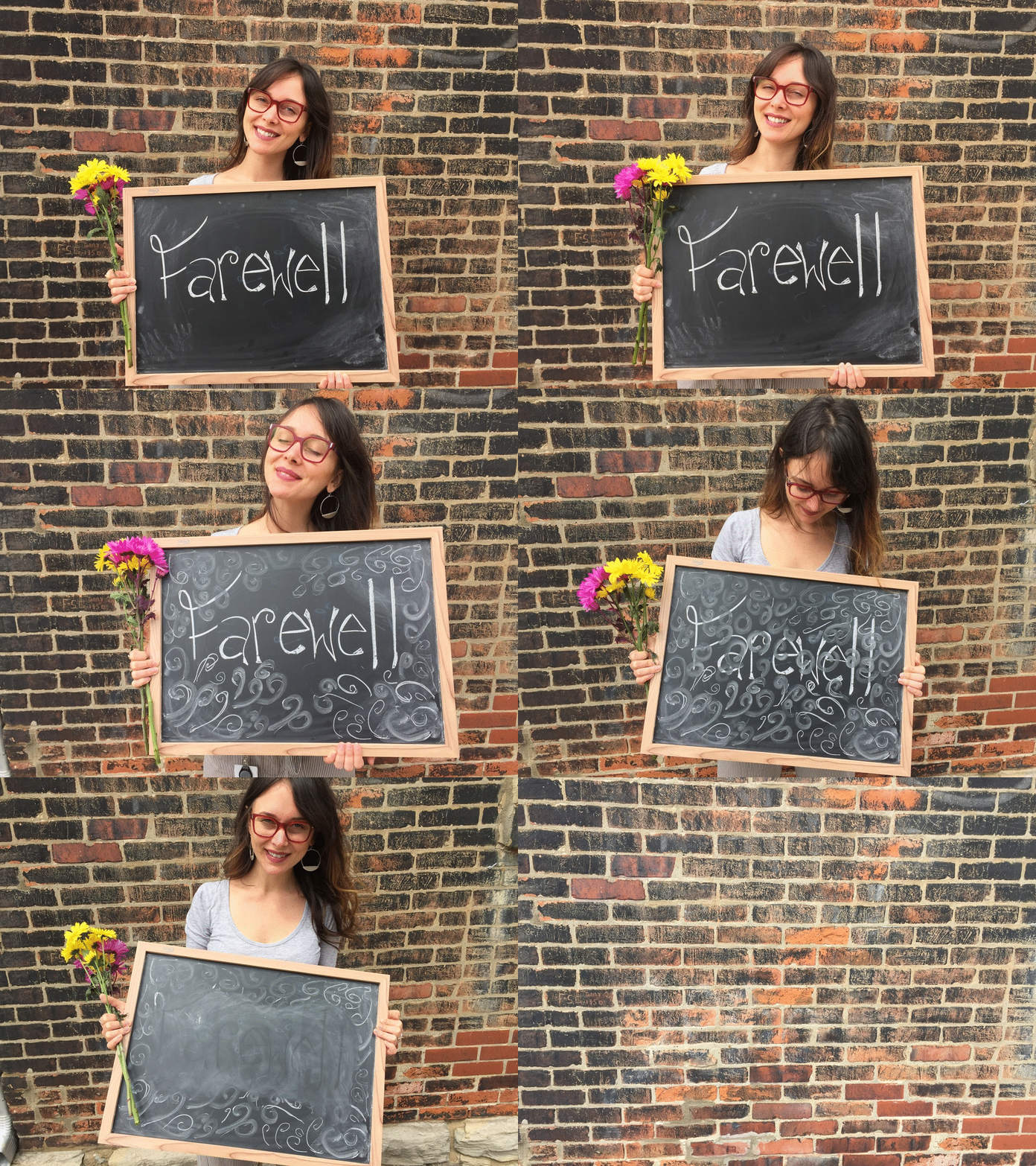
My Last Day
May 2017 - A farewell gif to my 2k+ Uber newsletter readers
Uber was my dream job.
I was in my early 20s working on the corporate side of things. It was exciting. Hard work. Long hours. Startup energy. Lots of, "We don't know, but you'll figure it out."
When I first met the Columbus team they were a dedicated and excited group of about 8 on a mission to change transportation forever. The idea was so brilliant that its success felt inevitable. At first I worked as a utility player contractor for about 6 months, doing everything I could to make a place for myself and become a “real” part of the team.
Even as a contractor, I could see the difference I was making. For example, while working in Uber's main office, I noticed that the Operations Managers were hosting driver onboarding hours. I thought they needed more available hours, and I could certainly elevate the human experience element of these driver interactions. I knew I could add a special touch.
One day, I asked if I could help with office hours. I was told no. The next day, I was doing it. That was the magic of Uber.
Soon, I was hiring and training a team, developing processes, and eventually helping scale those processes regionally and globally. At Uber, we had a wonderful company value: “Be owners, not renters”. I fully leaned into it. When I saw a gap, that gap became mine to fix.
I loved my driver support team. They were high-performing and endlessly agile in our rapidly evolving environment. The impact we were making was clear to me.
Then I was sent to Brazil for three months. A dream come true for me, as I speak Portuguese and always wanted to work there. But as I got to live out that career goal of mine, things took a turn for my support team back home.
"He Makes Me Feel Small"
While I was abroad, two people from my support team reached out separately because they were struggling with my direct manager who had been assigned to support them in my absence.
"He makes me feel small," one of them told me.
It wasn't the only concern I heard.
This manager had a reputation around the office. Unprompted, peers would approach me frustrated with this manager's behavior and say things like, "He shouldn't be managing anyone."
My direct team was struggling with the way he communicated and collaborated with them. They didn't feel supported or respected. Then one of them told me they were going to quit.
My heart sank. My dream team was crumbling. Previously I'd shielded them from direct interactions with this manager and I had underestimated the damage he could do in under 3 months.
I apologized. There was just a short time left until I would return. I asked them to stay.
They trusted me, so they did.
While I was still abroad, I made a plan for what I thought would be a mature, productive conversation with my manager when I returned.
My goal wasn't to get anyone in trouble. I wanted to protect my team. I wanted to share what they had experienced, address my own concerns about the way he communicated and collaborated, and hopefully help him understand the impact he was having.
The Meeting
When I returned from Brazil, we sat down in one of our office's small meeting rooms. It was a very Uber room. Cool lighting. A glass wall. An iPad mounted outside the door.
I followed the plan I'd made while I was away. Following my own bulleted list, I reviewed my team's feedback and shared my own concerns.
I remember trying to be soft and encouraging in my delivery. This wasn't a confrontation I wanted to win. I was trying to have a difficult conversation go well.
His reaction scared me. His face turned red. He became angry and his voice raised. He told me he couldn't believe I was telling him this.
Very quickly, it became clear that I was now the problem. Before I could finish my list of concerns, we ended the meeting.
I remember sitting there, surprised by his anger. Frustrated that he hadn't heard what I was trying to say. Nervous about what he would do next.
Then unease washed over me.
I had tried to have a mature conversation about a problem affecting my team. This type of direct conversation had been fruitful for me with others in the past. Hadn't this been the right thing to do?
The Performance Review
A few weeks later, I received my performance review.
It was terrible.
This was despite glowing reviews from my team and peers. Despite high praise from the leaders and peers I worked with in Brazil, where colleagues had watched me build up the national driver support program. Despite another senior manager from my office independently reaching out to my local General Manager to tell him that I had outgrown my Columbus title.
The rating effectively trapped me for the next few months. Because of it, I was not eligible to apply for other roles or receive a raise. More painful, I felt that all my efforts and huge accomplishments had become invisible.
I was devastated. No concrete examples were given to support the claims about my underperformance, despite the fact that the company had trained people managers on the process and emphasized the importance of citing specific examples in performance reviews.
I approached my General Manager and told him I suspected I had been retaliated against (A term I only just learned in sharing my situation with another manager). I cited the timing. The manager's behavior in our one-on-one. My performance. The feedback from my team. The feedback from colleagues who had worked alongside me in Brazil.
Once again I was made to feel like I was the problem. He waved away my concerns about retaliation and told me he would address my team's concerns directly with my manager. My performance rating stayed the same. Nothing about the experience was investigated in a way that I understood or could see.
My trust in the organization was shattered.
Leaving the Dream Job
Months later my manager got promoted to a role outside of our office and his role opened up. Many of the responsibilities of this role I had already been doing, without the title. Despite my peers' assumptions that I would, I didn't apply.
By that point, I realize looking back, I had already left emotionally.
I had given that company so much of myself. My time. My creativity. My energy. My heart. I had so willingly “drank the coolaid” as many of us would say referring to the cult-like culture around the brand. But when I tried to protect my team, I felt I was being punished for it. I had been treated like the problem.
At one point, outside of this story's timeline, my GM told me that the work I was doing- managing a team of support representatives, running a support office, working directly with drivers, building and scaling SOPs etc. - didn't require training.
"It should be something that anyone can do." he said.
That comment stayed with me.
Maybe it represented part of the disconnect.
The operational work was visible. But the work of building a team, instilling confidence in them, guiding them to be highly empathetic and patient in high-stress interactions, earning their trust, supporting them, creating an environment where they could do their best work was seen as skill-less work. Viewed by my leadership as something “anyone could simply do”.
Weeks after my direct manager was promoted, I remained a dedicated employee, but I was no longer myself. My heart was no longer in it. I called my favorite aunt and uncle who had brilliant careers in tech, and told them through tears I wanted to quit. They told me that I'd encounter this culture no matter where I'd go and that leaving Uber would be the worst decision of my career.
That same day, I put in my notice, letting leadership decide my last day. 3 weeks later I said goodbye to my dream job.
"Soft" Skills Are Not Soft
For years, I wondered whether I would eventually understand what had happened differently. Maybe, I thought, as I matured in my career, their leadership decisions would begin to make sense. Just maybe I was a naive 20 something too novice in my people management career to understand. I knew I still had a lot to learn.
But, I never did understand it differently.
In the years since leaving Uber, I continued to lead teams, build programs, and train others. Time only strengthened my early instincts that skills like active listening, support, collaboration, and the ability to build an environment of psychological safety should be considered essential skills, basically for any role, but especially leadership.
We call these things soft skills, as though they're somehow less concrete or consequential than technical skills. But their impact is anything but soft. The ability to make a person feel heard is not soft. Respect is not soft. The ability to communicate without making another person feel small is not soft. The ability to receive difficult feedback is not soft.
These are skills with real consequences. They take discipline and practice. They take intentional organizational effort to foster. But their value can too easily go unnoticed. Communication is easier. People contribute. Problems get surfaced before they become crises. Good leadership creates an environment of natural ease, the well-oiled machine effect, and that makes it easy to brush off as something that's effortless, skill-less.
But the opposite is loud and full of friction. When people don't trust their leadership, they disconnect. They stop sharing ideas. They work less hard. Or they leave, like I did. All those things have a very real impact on the bottom line.
Author and Harvard Business Professor, Amy Edmondson has dedicated years of research to psychological safety and what happens when teammates don't feel safe speaking up. Using examples from huge brands like Nokia, Wells Fargo, and Volkswagen, time and time again companies lost millions on top of huge losses in brand loyalty, traced back to environments where communication, trust, collaboration were elements that went undervalued. Where hierarchy and fear ruled the culture.
The cost of silencing people is not just hurt feelings. The cost can be extraordinary.
But Profits Aside
We spend an enormous amount of our lives at work. So beyond profits and performance, there is another reason to take these skills seriously.
What is the value of genuinely laughing with your team? Of being able to have hard conversations? Of challenging one another to stretch and grow? Of landing in a place where you've efficiently used the talents and brainpower of the people around you because they trust you enough to contribute?
What is the value of spending your working life, basically the BIGGEST portion of your life, with people you genuinely respect and who respect you?
We should all be extremely motivated for these reasons alone.
Getting There
It's no coincidence that 10 years later I cooked up a company dedicated to "soft-skills” training and building team connection. Looking back I can confidently say that the seeds of WitWorks were planted during this challenging time in my career.
And in the years since, there have been so many brilliant minds, like Amy Edmondson, Adam Grant, Liz Wiseman, and many others, doing great work to challenge the widely held belief that military-like hierarchy and fear are effective ways to lead teams. The data is in, folks. We know better now.
And with WitWorks there's a way to actually train on these skills. Your values can go beyond an onboarding slide and some beautifully stenciled words on your wall. You can invest in them. We can help you get there.
Perhaps a cultural shift in this direction seems daunting to you right now. If that's the case, I want you to remember, you're talking to a professional improviser here. I mean it when I say the goal is not perfection. You will interrupt someone. You will have bad days. You will occasionally make someone feel unheard without intending to. Our sessions can help you identify unhelpful behaviors, and get you trending in the right direction.
Because just like on stage, no amount of technical skill at work can justify the absence of humanity.
That's improv at work.