

Four Improv Tools for a VUCA World.
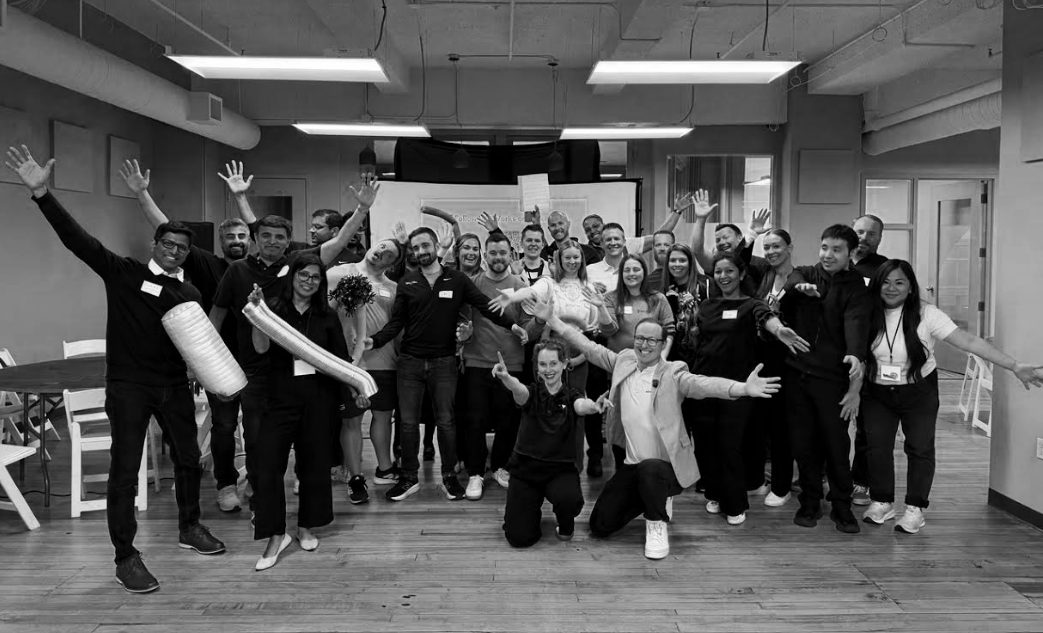
Alex and Katie at an Improv Workshop in Cleveland May 2026
The first time I heard VUCA, I was prepared to ignore it. When you’ve spent as much time in Learning and Development as Katie and I, you start to build up resistance to acronyms. It seems that every few months someone unveils their new framework, model, methodology, AI tool, or 3-4 part system (usually given an acronym) that promises to change the way we think about work. So when a facilitator showed a title slide focused on VUCA, my initial reaction was to check out as an L&D skeptic.
Then he explained what it stood for:
Volatility.
Uncertainty.
Complexity.
Ambiguity.
Once I started thinking about VUCA through the lens of improvisation, I realized something else.
Improvisers don’t just survive in a VUCA world, they develop habits that help them navigate those conditions more effectively.
The good news is that you don’t need to step onto a stage to practice them.
V is for Volatility.
Improv Tip:” Yes, and…If that’s true what else is true.“
Volatility is change happening quickly, often without warning. In the workplace this could take the form of a major client changing direction, project reprioritization, leadership changes, or discovering an empty coffee pot in the break room.
Most people’s first instinct is resistance. We spend a lot of our valuable energy wishing things were different than they are, especially when it comes to our trusted source of caffeine.
Improvisers learn a different response. At it’s core “Yes, and” begins with acceptance, not agreement or approval, simple acceptance. In improv when we are all on a sinking pirate ship, we don’t stop the scene to argue that we should have started the scene in a coffee shop. We accept the reality that has been presented and developed by the team and we build from there.
In the workplace, volatility as us to to the same thing. When circumstances change try asking:
“If that’s true, what else is true.”
Maybe the budget was cut, well if that is true then what else is true? This question shifts us from resistance to possibility, and when paired with Yes, and, it helps us stay in a state of assumed positivity as well. Instead of focusing on what was lost, we begin to explore what is now available. Most people freeze in these situations and the story becomes “We can’t do this anymore.” Instead if you think like an improviser and answer the question what else is true you find possibilities:
We need to be more selective about our priorities
We may have more freedom to experiment becuase expectations have changed.
Simplicity may become an advantage.
Notice that none of these statements dent the budget cut, the exercise simply prevents the budget cut from becoming the ONLY thing that’s true in your work.
Budget Cut = Contraction
If that’s true, what else is true? = Expansion
When the budget gets cut an improviser’s response isn’t toxic positivity. they don’t pretend the is good news. They simply recognize that the budget cut is not the only thing that is true. By asking “If that’s true, what else is true? they uncover new constraints, opportunites, and information that can help them more forward.
U is for Uncertainty.
Improv Tip: Make the Next Obvious Choice
Uncertainly is different than volatility. Volatility is when things change, Uncertainty is when you don’t know what’s coming next.
Improvisers experience uncertainty every time they walk onto the stage. Nobody knows where the scene is headed, how the scene will end, or if the next line will unlock something brilliant or create an entirely new set of problems.
The mistake many people make when facing uncertainty is believing they need MORE information before taking action. Now yes, sometimes this is true and you DO need more information, but often it isn’t true.
Improvisers learn that waiting for certainly is a great way to kill a show. (we talk about this in Trusting your Gut) Instead, they focus on making the next obvious choice.
Let’s say your scene partner says, “Welcome to your first day at the dragon academy,” you don’t need to know the entire plot, you only need to know what is happening right now in that moment. Maybe you are in the instructor, or maybe you are holding a dragon egg. Choose something and keeping it moving. Making an obvious choice also makes your audience feel smart and makes you look like a genius. When you make an obvious choice, often times your audience is thinking of that make choice (it is an obvious one after all). When this happens your audience thinks “Hey! That’s what I was thinking” and that connection to the work on stage often creates the moments the audience laughs at the most, making you look like a genius.
In the workplace uncertainty often sounds like:
We don’t know..
How AI will impact our industry…
How customers will respond…
What leadership will decide…
What next year looks like…
Those all may be true, so the next question becomes “What’s the next obvious choice?”
Not the perfect choice or the end all be all final choice. Just the next one.
Obvious action often creates clarity faster than analysis during times of uncertainty.
C is for Complexity.
Improv Tip: Make your Partner Look Good.
Complexity shows up when multiple factors influence a situation at the same time.
This could look like different stakeholders, competing priorities, conflicting goals, or too many options for coffee syrups and add ins.
Many workplace problems are complex because nobody owns the entire picture.
The same is true in improv. An improviser can’t create a great scene alone. (That’s more like stand up)
The best performers understand a simple truth:
Your job is to make your partner look good.
When everyone adopts that mindset, stuff starts to work in a way it didn’t before. People listen more carefully, they become more supportive, they contribute instead of compete, and the scene (or company, project, assignment etc.) gets stronger because nobody is trying to “win”.
Imagine how different workplace collaboration would feel if every team member entered a meeting asking:
"How can I make my partner look good?"
That question shifts attention away from individual recognition and toward collective success.
In complex environments, that shift matters.
Because complexity is rarely solved by individual brilliance.
It's solved through collaboration.
A is for Ambiguity
Improv Tip: Give a Gift
Ambiguity exists when we're unsure what something means.
In the workplace, ambiguity often shows up when information is incomplete or open to multiple interpretations. A new initiative is announced. A leader makes a surprising decision. A customer behaves in an unexpected way.
Everyone sees the same event and not everyone sees the same meaning.
Improvisers face this challenge all the time.
Imagine a performer walks on stage carrying an imaginary object.
A newer improviser might ask: "What do you have there?"
While that's a reasonable question, it places all the responsibility on their partner to create meaning.
An experienced improviser often does something different.
They give a gift.
"What's up with the bomb you're holding?"
"I can't believe you stole the mayor's trophy."
"You brought Grandma's ashes to the wedding?"
Suddenly the scene has direction.
The partner doesn't have to create meaning from scratch. They've been given something to react to, confirm, deny, or build upon.
Importantly, the gift doesn't have to be correct.
It just has to be useful. Maybe it isn't a bomb. Maybe it's a cake.
That's okay.
The scene can still move forward because someone made a choice.
The same principle applies at work.
When ambiguity exists, teams often get stuck waiting for perfect clarity.
Improvisers teach us another option. Offer a possibility. Create a starting point.
Give people something to build on.
Instead of saying:
"I have no idea what's happening."
Try:
"One possibility I'm seeing is..."
"Here's how I'm interpreting this."
"What if we approached it this way?"
A gift creates momentum.
Others can refine it, improve it, redirect it, or challenge it.
But they now have something concrete to respond to.
In a VUCA world, ambiguity doesn't disappear because someone magically finds the answer.
Often, it disappears because someone is willing to make an offer and invite others to build on it.
That's the gift.
Dont be afraid of VUCA
Looking back, I do augh at my initial reaction to VUCA.
I thought it was just another acronym. Instead, it gave me language for something I'd been experiencing for years as an improviser.
Every improv scene is a VUCA environment. Things change unexpectedly. Information is incomplete. Multiple ideas compete for attention. Meaning isn't always immediately clear.
Yet improvisers move forward.
They accept reality and ask, "If that's true, what else is true?"
They make the next obvious choice.
They focus on making their partners look good.
They give gifts that others can build upon.
The workplace isn't much different.
The plan changes. Priorities shift. New challenges emerge.
The script keeps changing.
Fortunately, that's exactly what improvisers train for.
If your team is struggling to navigate volatility, uncertainty, complexity, or ambiguity, the answer may not be another process, meeting, or strategic plan. It may be developing the adaptability, communication, and collaboration skills needed to thrive when the path forward isn't perfectly clear.
That's exactly what we help teams build at WitWorks through Improv at Work.