
As an improv instructor for adult classes, and a professional improv performer, I often hear from students and audience members about a surprisingly quirky recommendation from their therapist to “try improv”. In my own 15 years of experience in the art form, I've seen how improv can change people’s lives for the better, but I was curious. What are the benefits from the clinical perspective?
I decided to find out. I put a post out on Instagram calling all improv-recommending therapists. Lucky for me, two responded, Alex Shaver, LPCC-S and Lindy Zahrndt, who both shared some amazing insights. Check out their interviews below:
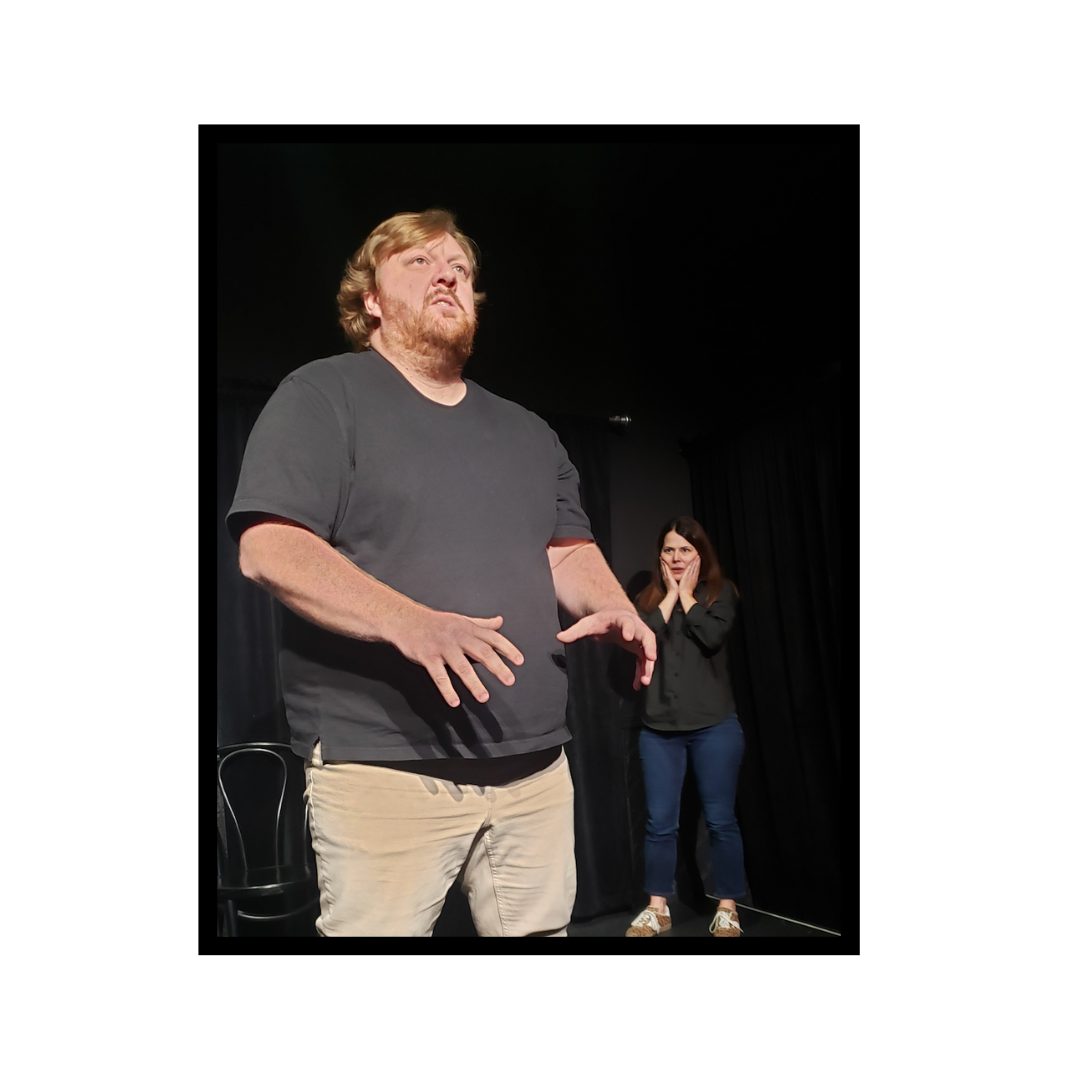
Pictured Alex Shaver and Marissa Leonino Lange.
Meet the Therapist
Name: Alex Shaver, LPCC-S
Location: Cleveland, and with virtual clients across Northeast Ohio.
Area of expertise: Trauma, Community Mental Health
So tell me Alex, what is your own experience with improv?
Improv was always an itch I wanted to scratch. I grew up watching SNL and goofing around with friends, but it wasn’t until after I became a parent that I took my first improv class at Imposters Theater here in Cleveland, Ohio. Since then, I’ve completed the curriculum and multiple advanced workshops. I now perform at Imposters as part of a longform group, IKEA Near Me, and a Harold trio, Booze and the Boys. I’ve also recently started coaching.
I started improv as a practice in self-care. Improv has been a creative outlet just for me; one that helps me be present and channel my anxiety. I never saw myself being as involved with improv as much as I am now: auditioning for teams, and performing out of state. It's been such a gift.
You said you have recommended improv to some of your clients. What's made you recommend it?
Some clients express interest in the arts. Whether it’s a desire to push themselves out of their comfort zone or to practice being present or vulnerable in safe ways, improv is great for that.
With improv you can surprise yourself. One thing I think a lot about is: Who gives you the permission to be who you want to be? I do a lot of work around autonomy and agency. When you’re able to get on stage and be literally anything—like a captain of a pirate ship—you get to practice this agency and power that you can try on for a little while. You can practice being a character that is joyful, even though you may not feel joyful in real life.
So many of our anxious thoughts or cognitive distortions—the stories we tell ourselves—are stamped in. The unique opportunity to practice confident characters on stage, for example, has some real implications for surprising clients, giving them “I didn't know I had that in me,” moments. And whether or not they realize that, they’re getting the opportunity to practice those things. It helps.
With improv you can practice therapeutic concepts like the “Opposite Action Skill” which helps build emotional awareness and response control before taking action. Improv is also very relevant to DBT (Dialectical Behavior Therapy) more generally, which focuses on building mindfulness, distress tolerance, emotional regulation, and interpersonal effectiveness.
Who might not be a good fit for this art form?
Maybe someone who is not ready to write their own story yet. Someone who is not quite ready to be connected with someone else or be vulnerable with others. Maybe someone who has had a recent traumatic experience that they haven't processed yet.
But there's room for everyone. There is no one way to be an improviser. Those emotions and experiences you have: you bring all of that with you. And in improv, they become gifts. You might surprise yourself.
WitWorks is all about finding Improv's application to the workplace, so of course I have to ask. Are there any particular workplace skills or behaviors you think improv could be especially effective at developing?
Oh, yeah. Clarity in communication. Avoiding passive aggressive behavior in communication. Collaboration. When I’m onstage with my teammates, it can’t be the Alex show. We have to really value each other's input. If we don’t, no one is going to enjoy the show or get anything done.
Improv's approach to support work is especially relevant for leadership. You have the opportunity to see things that are hard to see if you’re really listening. You have an opportunity to build people around you to make them better.
Any Final Thoughts?
It can be hard to connect with people in real ways. I continue to be amazed by the ways people continue to choose to connect, including in this artform. People mine for joy in places—even in places they think they might fail—, and they find good things. It says a lot about them. I feel grateful to be able to do this work.

Meet the Therapist
Name: Lindy Zahrndt
Location: Grandview, Ohio
Area of expertise: Private Practice, LL Zahrndt Psychotherapy, LLC, specializing in trauma, general mental health (teen issues mostly with teens but also adults. Lindy is also an associate of Athletic Mind Institute, under Dr. Todd Kays, an OSU Sports Psychology Professor and the owner of AMI.
What's your experience with improv, Lindy?
I think I took my first class in 2022 and have been performing about every month ever since with an Improv troupe Meat Fish Produce. I actually got into improv because one of my clients brought it up! Everyone is creative. I sing and play guitar, but not as often as I used to, so I thought I would take an improv class. I would come home every night after class and my face would hurt from laughing. I really bonded with my group.
You said you have recommended improv to some of your clients. What made you recommend it?
This comes up for me maybe a couple times per month. So many kids are dealing with anxiety. It's at an all-time high for youth right now. Multiple times I'd interact with clients via telehealth, who once I was meeting with in person, they would completely shut down. So, improv seemed like a great option for these kids.
Improv could be a version of what we call in psychotherapy, gradual exposure therapy. For example, if someone is afraid of flying, a first step to managing that fear would be to just take them to the airport, and then go home. With improv, first you build up trust with each other, then you take further steps to dive deeper. And it's silly fun that is especially needed for kids.
Young people can be so worried about what others think, a societal challenge that social media has really contributed to. Social media is going to keep me in business. With student athletes, they can often be so driven toward perfectionistic tendencies, that they can make themselves sick. Perfectionism is the killer of joy. Looking silly for these types of kids is the last thing they want, but improv can be a controlled and safe way for them to experience embarrassment. These controlled exposures then help in the real world when failure or embarrassment is out of their control. Teaching kids to laugh at themselves is huge.
I've recommended improv for adults as well for this reason. And it can be a great creative outlet for adults.
Why are creative outlets important for adults?
They allow you to connect with yourself. They can help you get out of your head and into your body. With anxiety, in order for the brain to slow down, the body must slow down first. We're animals. Our bodies take in information, even subconsciously, that makes us anxious. When you're up on stage, moving your body, aware of your body, you're forced to be connected with it.
When it comes to the workplace, are there any skills or behaviors that this art form would be particularly helpful in developing?
Accountability comes to mind first. It's not a cure-all, but improv can lessen the fear of being exposed. It has a way of lowering defensiveness. It also helps with confidence. Public speaking is society's number one fear. Improv innately gives students and performers lots of practice in that.
Also, when you’re happier in your workplace you do better. Laughing releases so many positive neurotransmitters and lowers cortisol. In my experience, it was the people that made me laugh that kept me at a workplace that was ultimately not a good fit for me. I know that's true for so many people. Workplaces have every incentive to invest in building communities where people like being around each other.
After speaking with Alex and Lindy, I was curious about all those client-turned-improvisers. Are they getting out of improv what their therapists had intended for them? I had more questions to ask. I reached out to some former students of mine, in search of a patient turned improviser who'd be willing to chat.

Meet the Improviser
Name: Frank Miller
Location: Columbus, Ohio
Area of Expertise: Logistics
Okay, Frank. Tell me about your improv origin story.
Well I was always the class clown. I loved eyeballs on me. As a young person I became an opioid addict and then went to recovery and with that started speaking publicly often in meetings. After some really challenging experiences I developed a phobia of public speaking, so I stopped speaking at those meetings. I kept going, but would just be quiet.
Then in 2019 a lot of life happened. I moved to a new place without friends. My best friend got cancer. I took on a lot more responsibilities at work. I was in a really low place. I remember being at a Hockey Game and everyone around me was chanting. For some reason, I couldn't even join in with the chanting. I had such a fear of looking silly. Once my fiancee realized the state of my mental health, she gave me an ultimatum to go to therapy.
My then therapist suggested improv for public speaking, because after all that time, it still bothered me so much that I couldn't speak in front of people. I did some improv research on my own, and then found a theater in St. Louis called The Improv Shop. This was during covid, so I signed up for classes that were six months out. Six months later, I started classes.
Was your therapist right? Was improv helpful?
Yes. So, when classes started up, I originally had no intention of finishing their entire curriculum. I felt fear at first, but the class was authentically supportive. Others in class with me were anxious too, some even more so than me. There's a lot of comfort in knowing everyone was feeling a bit uncomfortable. I quickly started developing friendships and continued taking classes to stay with my friends.
That fear of public speaking I had melted away. The feeling became nerves I could handle, instead of panic. It felt really good. Prior to classes my identity had become “being a sad person”, but when I was doing improv, you can't always play the same character. I had this permission to be and feel something else. Our class had us intentionally playing four core emotions; mad, sad, glad, afraid. It was cool to play with all of these. And it was a true practice in staying present.
And sometimes, when I didn't have the capacity to play anything but sad, my improv instructor was so supportive, and told me to come to class anyways, and use the emotion I had. So I did, and it was great.
I really feel like that improv community saved my ass. People need their village and these people were very open minded, intelligent artists, many of whom were struggling with there own struggles in life. But we could laugh together about anything. Many of them became the best friends I've had in my life.
I tell people to do improv all the time. People benefit from having a platform to practice vulnerability.
Has your experience with improv impacted the way you show up at work?
Yes! For one, improv taught me or allowed me to practice open mindedness and collaboration. I found myself more open minded to those who report to me, and more collaborative with peers. Improv also became such a large part of my life that it allowed me to reframe the importance of career. I evaluated what "success" in life looked like. A minor failure at work no longer emotionally crippled me entirely. This had a tremendous benefit to my mental health, which ironically helped me show up as my best self in the workplace and become 10x better at leading people.
Final Thoughts
So there I have it, and now there you have it!
Therapists are identifying skills that impact personal and professional development. The same qualities that help someone navigate an improv scene, listening, collaboration, adaptability, confidence, and comfort with uncertainty, are qualities that make people more effective friends, partners, colleagues, leaders and more.
I think it's worth being clear that improv isn't a substitute for therapy or clinical treatment. But as I learned through these conversations, it can offer a unique environment to practice some of the very skills therapists work to develop with their clients.
The curiosity behind this article had been on my mind for over a year, and I'm so glad to have had this opportunity to explore it. An enormous thank you to Alex, Lindy, and Frank for sharing your wisdom and experiences, and for helping me bring this little idea bubble into real life. Thank you, thank you!